
Modelling of high salt intake effect on renal interstitial fibrosis


Date of publishing
2018-02-14Type of publication
info:eu-repo/semantics/conferencePaperSubject(s)
Enfermedades renales
Fibrosis
Matriz extracelular
Modelo matemático
Riñón
Sodio en la dieta
Kidney diseases
Fibrosis
Extracellular matrix
Mathematical models
Kidney
Sodium, dietary
Fibrosis
Matriz extracelular
Modelo matemático
Riñón
Sodio en la dieta
Kidney diseases
Fibrosis
Extracellular matrix
Mathematical models
Kidney
Sodium, dietary
Abstract
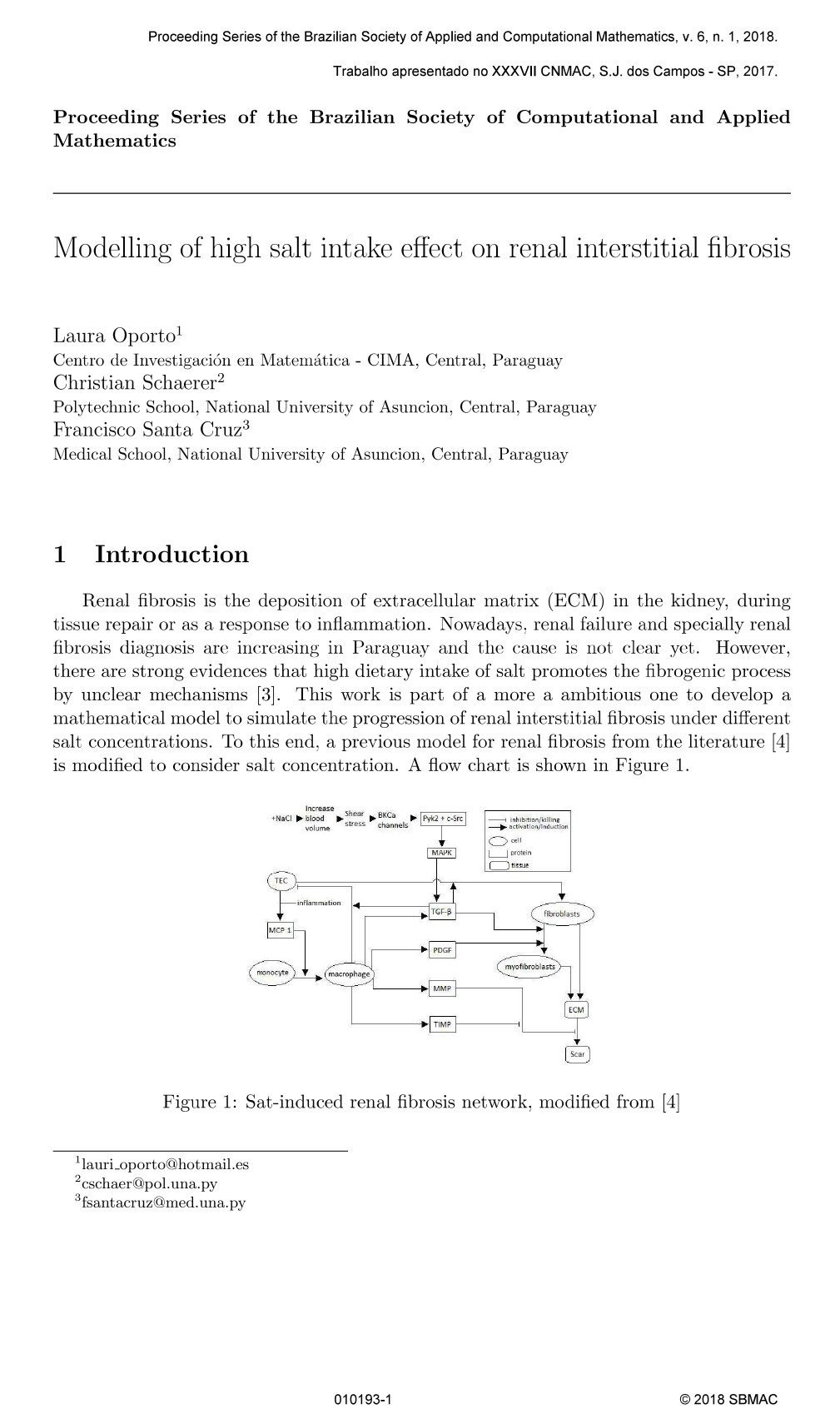
Introduction. Renal fibrosis is the deposition of extracellular matrix (ECM) in the kidney, during tissue repair or as a response to inflammation. Nowadays, renal failure and specially renal fibrosis diagnosis are increasing in Paraguay and the cause is not clear yet. However, there are strong evidences that high dietary intake of salt promotes the fibrogenic process by unclear mechanisms. This work is part of a more a ambitious one to develop a mathematical model to simulate the progression of renal interstitial fibrosis under different salt concentrations. To this end, a previous model for renal fibrosis from the literature is modified to consider salt concentration. A flow chart is shown in Figure 1.